
The Dukore Twigire Project (DTP) represents a unified effort to address the long-term economic needs of Forcibly Displaced Populations (FDPs) and their host communities. Moving beyond temporary aid, this project focuses on “durable solutions”—creating permanent pathways out of extreme poverty.
This initiative is delivered through a strategic consortium. While World Vision Rwanda serves as the lead, the implementation is shared among partners to ensure localized expertise. As the Rwanda Organization for Development Initiatives (RODI), we work alongside our partners to ensure that every targeted household, regardless of location, receives the same high standard of support.
The Power of Numbers: Reaching 2,133 Households Across Four Districts
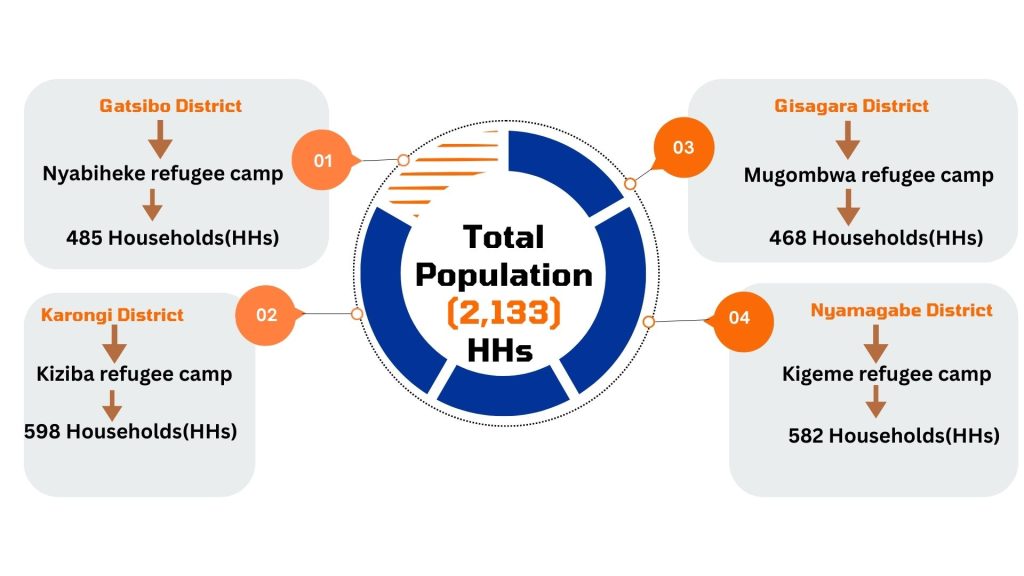
To achieve national impact, the project has been strategically deployed across four distinct districts. The total target of 2,133 households is not a monolith; it is a carefully calculated distribution designed to support the specific refugee camps and surrounding communities in each province.
The breakdown of our collective reach is as follows:
- Karongi District (Western Province): This area has the largest concentration of beneficiaries. The project supports 598 households associated with the Kiziba refugee camp. Interventions here focus on overcoming the steep terrain challenges to create viable agricultural and trade livelihoods.
- Gatsibo District (Eastern Province): In the East, the project targets 485 households linked to the Nyabiheke refugee camp. Partners in this district are working to integrate these families into the broader regional economy, ensuring that refugees have access to markets beyond the camp boundaries.
- Gisagara District (Southern Province): Supporting 468 households around the Mugombwa refugee camp, the project here emphasizes financial inclusion, helping families build savings and access credit to start small businesses.
- Nyamagabe District (Southern Province): This is the heart of RODI’s operations. We are responsible for 582 households linked to the Kigeme refugee camp.
RODI’s Specific Mandate in Nyamagabe District
As RODI, our implementation is firmly rooted in Nyamagabe District. We are directly accountable for the 582 households under our care. Our strategy is built on inclusivity and social cohesion, strictly adhering to the project’s mandate to serve both displaced persons and Rwandan citizens.
Our beneficiary structure in Nyamagabe is as follows:
- 407 Refugee Households (70%): These families are identified from within the Kigeme refugee camp.
- 175 Host Community Households (30%): These families are Rwandan citizens living in the sectors immediately surrounding the camp.
For us, this 70/30 split is more than a statistic; it is a tool for peacebuilding. By training a refugee from Kigeme alongside a Rwandan neighbor from Nyamagabe, we break down silos. They join the same Village Savings and Loan Associations (VSLAs), attend the same business training, and often trade with one another. This shared experience fosters a community where “self-reliance” is a collective achievement rather than an individual pursuit.
The Ultra-Poor Graduation (UPG) Model
Across all four districts—from Karongi to Gatsibo—the consortium utilizes the Ultra-Poor Graduation (UPG) model. This evidence-based approach is sequenced to guide households from vulnerability to stability through four key pillars:
- Social Protection: Ensuring basic needs (food security, health access) are met so families can focus on the future.
- Livelihood Promotion: Providing the assets and technical skills necessary to launch sustainable income-generating activities.
- Financial Inclusion: Connecting households to savings groups and formal financial institutions to manage risk and invest in growth.
- Social Empowerment: Building confidence and community integration, ensuring that marginalized groups (including women and people with disabilities) have a voice.
Expected Outcomes
By harmonizing our efforts across these four districts, the DTP aims to deliver measurable, lasting change. For the 2,133 households we collectively support, we anticipate:
- Economic Independence: Families will transition from relying on humanitarian consumption support to managing their own sustainable businesses.
- Diversified Incomes: Households will no longer rely on a single, fragile source of income but will have multiple revenue streams.
- Strengthened Social Fabric: The tension often found between refugees and host communities will be replaced by economic collaboration and mutual support.
Conclusion
The Dukore Twigire Project is a testament to what can be achieved through partnership. Whether it is the 598 families in Karongi, the 485 in Gatsibo, the 468 in Gisagara, or the 582 families we personally serve in Nyamagabe, the goal remains the same. We are building a Rwanda where displacement does not define a family’s future—their resilience does.
