
Historically, global social protection programs were often viewed as permanent “safety nets”—charitable systems designed simply to catch people when they fall and keep them hovering just above the starvation line. Today, in Rwanda, we recognize that an effective social protection system must be a “Springboard for Graduation.” It is not about managing poverty; it is about engineering a permanent exit from it. It is about providing the precise combination of financial assets, education, and health interventions required to transition a family from dependency to absolute self-reliance (Kwigira).
This blog post explores how modern social protection is the ultimate catalyst for human dignity, and how integrated, grassroots interventions are ensuring that every Rwandan has the opportunity to graduate into prosperity.
The Three Tiers of the Graduation Pathway
To successfully graduate a household out of extreme poverty, social protection must be holistic. At the Rwanda Organization for Development Initiatives (RODI), we operationalize this graduation pathway across our entire current project portfolio. We do not view social protection as a standalone department; it is the vital thread that connects our interventions in education, economic resilience, and early childhood health.
1. Educational Protection: Breaking the Generational Cycle (The LIFT Project)
The most sustainable form of social protection is an inclusive education. When a child drops out of school due to extreme poverty or disability, they are immediately stripped of their future earning potential, guaranteeing that the cycle of poverty will continue into the next generation.
In Rusizi District, our Learning and Inclusion for Transformation (LIFT) project serves as a robust educational safety net. Operating in a strategic consortium with ADEPE and UPHLS, we are currently protecting 1,516 children and youth.
- Targeted Inclusion: Through our partnership with UPHLS, we extend social protection to children with disabilities—a demographic historically excluded from the classroom. By providing assistive devices, we protect their fundamental right to learn.
- The Social Safety Net Linkage: We understand that a child cannot focus on a chalkboard if their family is starving. Through ADEPE, we link the most vulnerable households directly to national social protection schemes. This economic buffer ensures that a sudden financial shock at home does not force a youth to abandon their Alternative Learning Pathway (ALP) to seek casual labor.
2. Economic Protection: Building Household Buffers (Dukore Twigire)
For families facing extreme fragility—such as Forcibly Displaced Populations and their Host Communities—social protection must provide immediate economic stabilization followed by asset growth.
Through the Dukore Twigire Project in Nyamagabe District, we are currently building economic resilience for refugees in Kigeme Camp and their Rwandan neighbors.
- The Asset Transfer Springboard: We provide highly vulnerable households with productive assets, such as small livestock. This is the “promotion” phase of social protection. The asset provides a continuous, sustainable income stream that protects the family from market fluctuations and food insecurity far better than a one-time cash handout.
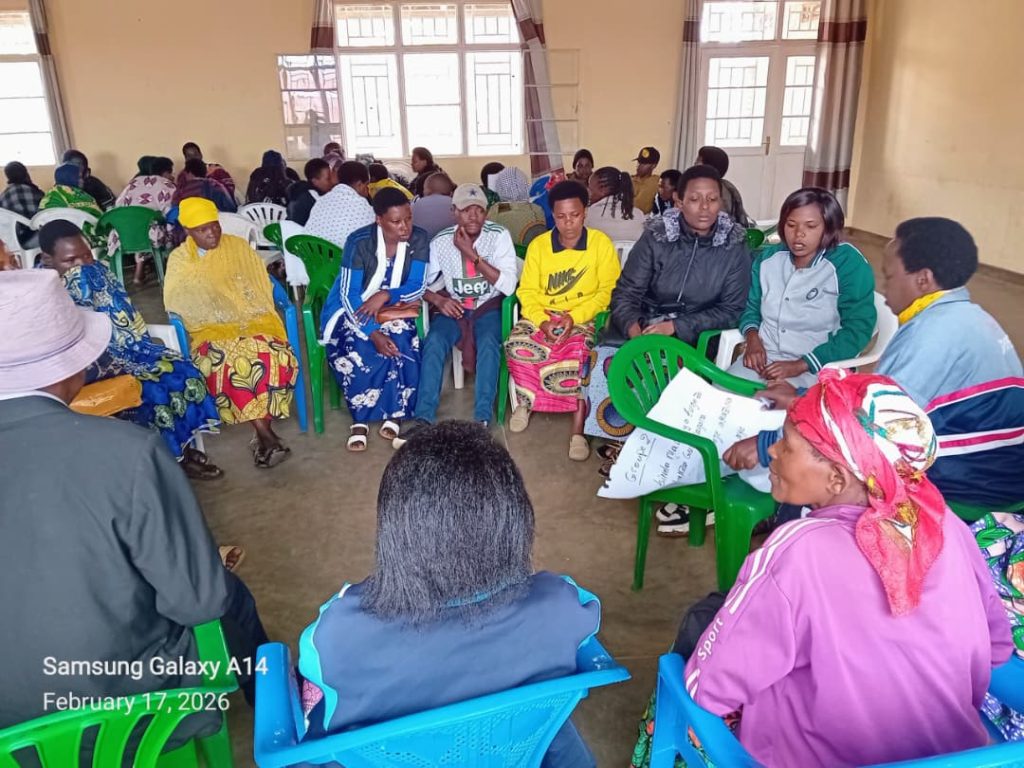
- Community-Owned Insurance (VSLAs): We facilitate mixed Village Savings and Loan Associations (VSLAs). These groups represent the ultimate decentralized social protection system. Beyond personal savings, every VSLA maintains a “Social Fund.” If a refugee mother falls ill or a host community father loses his roof in a storm, the group disperses an emergency grant. This ensures that the community itself holds the safety net, creating profound social cohesion and trust.
3. Health Protection: Defending the First 1,000 Days (ECD in Ruhango)
Social protection must begin at birth. If a child suffers from severe malnutrition during their earliest years, the resulting physical and cognitive stunting acts as a permanent barrier to their future graduation from poverty.
In Ruhango District, our ECD Monitoring and Supportive Supervision program functions as a frontline social protection mechanism for infants and toddlers.
- Nutritional Security: Our highly trained ECD Caregiver Graduates actively protect children from hidden hunger. By enforcing strict Water, Sanitation, and Hygiene (WASH) protocols and conducting rigorous growth monitoring, they create a protective shield against the illnesses that drive malnutrition.
- Protecting the Family Economy: When parents are trained by our caregivers to cultivate Kitchen Gardens (Akarima k’igikoni), they are practicing economic protection. They secure a free, daily source of essential vitamins, completely insulating their child’s dietary diversity from the volatile prices of the local market.
The Engine of Graduation
Assets, school fees, and kitchen gardens are the physical tools of social protection, but the graduation model requires a psychological catalyst to succeed. Long-term poverty often inflicts deep psychological scars, creating a devastating sense of helplessness.
To ensure our beneficiaries permanently graduate from these social safety nets, RODI drives every intervention with a powerful behavioral change strategy: “Enough Thinking.”
We do not simply distribute resources; we actively reshape the cultural mindset of vulnerability. We make sure to teach our communities that they should adopt a radically new perspective on their own capacity to thrive:
- Saying “Enough” to the Identity of Poverty: We make sure to teach beneficiaries they should say “Enough” to viewing themselves as permanent “victims” who require endless aid. Whether speaking to a displaced family in Kigeme or a struggling parent in Rusizi, we teach them that they should view social protection as a temporary investment in their ultimate self-reliance.
- Saying “Enough” to Reactive Living: Vulnerability forces families to live solely for today. We make sure to teach them they should say “Enough” to short-term survival tactics. We instill the discipline of proactive defense. We teach them that they should continuously contribute to their VSLA Social Funds, ensuring they are always prepared to protect themselves against the next inevitable crisis.
- Saying “Enough” to Exclusion: We make sure to teach communities they should say “Enough” to leaving anyone behind. We teach them that true social protection is a collective responsibility. We emphasize that they should actively embrace youths with disabilities and support displaced families, realizing that a community is only as resilient as its most vulnerable member.
Conclusion: The Bridge to Vision 2050
In 2026, social protection in Rwanda is not a mechanism for managing poverty; it is the strategic bridge to prosperity.
It is the promise that a sudden illness, a displacement, or a disability will not dictate the trajectory of a person’s entire life. Through the integrated efforts of the LIFT Project, the Dukore Twigire Project, and our ECD Caregiver Graduates, RODI is proving that the graduation model works. By combining educational inclusion, economic asset transfers, early childhood health, and the empowering psychology of the “Enough” mindset, we are building a safety net that eventually turns into a launchpad.
We are proud to stand alongside our consortium partners and the communities we serve. Together, we are ensuring that as Rwanda races toward the economic triumphs of Vision 2050, every single citizen has the protection, the tools, and the dignity to run the race with us.
