
The narrative surrounding forced displacement is undergoing a profound shift. For decades, refugees and internally displaced persons were viewed primarily through a humanitarian lens—as recipients of aid, dwelling in temporary camps, waiting for a safe return home. However, the reality in Rwanda tells a different story. Displacement is often protracted, lasting for years or even decades. The “camp” is no longer just a shelter; it is a community, a market, and a potential engine for economic growth.
Rwanda has long been a global leader in progressive refugee policies. Under the Second National Strategy for Transformation (NST2) and the Comprehensive Refugee Response Framework (CRRF), the government has championed a vision where refugees are not kept apart from society but are integrated into national systems of education, health, and crucially, the economy.
Today, the focus has moved decisively toward Livelihood Development. The goal is to transition forcibly displaced populations from reliance on dwindling humanitarian aid to self-reliance. But this transition cannot happen in isolation. It must include the Host Communities—the Rwandan neighbors who live just outside the camp boundaries and often face the same economic struggles.
This blog post explores the complex dynamics of building livelihoods for displaced populations and their hosts. It examines why economic integration is the only sustainable path forward and how targeted interventions are turning zones of displacement into zones of shared prosperity.
The Challenge: Shared Vulnerability in a Crowded Landscape
To understand livelihood development in this context, one must first understand the “Dual Vulnerability” that characterizes these regions.
1. The Resource Strain
Rwanda is one of the most densely populated countries in Africa. Land is scarce. When a refugee camp is established, it places immediate pressure on local resources—water, firewood, and grazing land. If refugees are supported while host communities are ignored, tensions inevitably rise. A host community farmer may look at the camp and see free food and services that they do not have access to, despite living in similar poverty.
2. The “Aid Dependency” Trap
For years, the standard model of support was the monthly food distribution or cash transfer. While necessary for survival, this model inadvertently crippled local economies. It created a “waiting culture” where refugees felt they could not work or invest because their future was uncertain. In 2026, with global humanitarian funding shrinking, this model is no longer viable. The only safety net that remains is the one the community builds for itself.
3. The Economic Potential
However, within this challenge lies a massive opportunity. Refugees bring skills, resilience, and diverse cultural knowledge. They are traders, artisans, teachers, and farmers. When these skills are unlocked and combined with the local knowledge of host communities, the result is an economic multiplier effect. A thriving camp market attracts local suppliers; a successful refugee business pays local taxes and employs local youth.
Strategies for Integrated Economic Growth
Successful livelihood development for displaced populations in 2026 relies on three strategic pillars: Market-Based Interventions, Social Cohesion, and Financial Inclusion.
Market-Based Interventions: Beyond “Digging Holes”
In the past, livelihood projects were often disconnected from reality—training refugees to make crafts that no one wanted to buy. Today, interventions are deeply rooted in market analysis. If the local demand is for processed cassava, livelihood projects focus on cassava processing machines. If the demand is for construction services, projects focus on vocational training in masonry. The goal is to create Sustainable Income Generating Activities (IGAs) that survive without donor support.
Social Cohesion: Peace Through Trade
The most effective peacebuilding tool is a shared business interest. When a refugee and a host community member co-own a milling machine, they are forced to cooperate. They share the profits, they share the risks, and inevitably, they share a bond. Livelihood development is, therefore, a security strategy. It weaves the two communities together so tightly that conflict becomes economically damaging for everyone.
Financial Inclusion: The Right to Save
You cannot build a business without capital. Yet, refugees have historically been “unbanked,” perceived as high-risk borrowers with no collateral. Breaking this barrier is essential. By establishing saving groups that accept both refugee IDs and national IDs, development actors are unlocking the liquidity needed to fuel small businesses.
RODI’s Contribution: The Dukore Twigire Project
At the Rwanda Organization for Development Initiatives (RODI), we are actively translating these high-level strategies into on-the-ground reality. We understand that policy papers do not put food on the table; practical, community-led projects do.
We are currently implementing this project in Nyamagabe District, specifically targeting the Kigeme Refugee Camp and the surrounding Host Communities. This is a challenging environment—steep hills, soil erosion, and a high density of vulnerable households. In this context, the line between a “poor refugee” and a “poor local” is often blurred. Both struggle with the same climate shocks and the same lack of capital.
Our Interventions: Building Shared Resilience
The Dukore Twigire Project focuses on bridging the gap between these two groups through integrated economic activities:
- Mixed Cooperatives and Enterprises:
We do not create “refugee co-ops” and “local co-ops.” We create Mixed Groups. In these groups, a refugee woman might be the Treasurer while a host community man is the President. They work together on joint ventures—whether it is a pig-rearing project, a tailoring workshop, or a collaborative agriculture plot. This integration reduces prejudice and builds a shared safety net. - Asset Transfers for the Most Vulnerable:
We identify the “ultra-poor” in both communities—those who have fallen through every other crack. We provide them with productive assets to jumpstart their journey to self-reliance. This includes:
- Small Livestock: Providing pigs and goats which act as “living banks” and provide manure for crops.
- Off-Farm Business Kits: Providing tools and stock for petty trade, salon services, or carpentry.
- Financial Inclusion via VSLAs:
Every beneficiary group is anchored by a Village Savings and Loan Association (VSLA). We facilitate these groups to save small amounts weekly, creating a loan pot that members use to expand their businesses or pay for emergencies like school fees or healthcare.
The “Enough” Mindset: Teaching Transformation
Perhaps the most critical component of the Dukore Twigire Project is the behavioral change aspect. We believe that physical assets (like goats or money) are useless if the mindset of dependency remains.
Therefore, within the project, we engage in a rigorous mindset change campaign rooted in “Enough Thinking.”
- Saying “Enough” to Dependency:
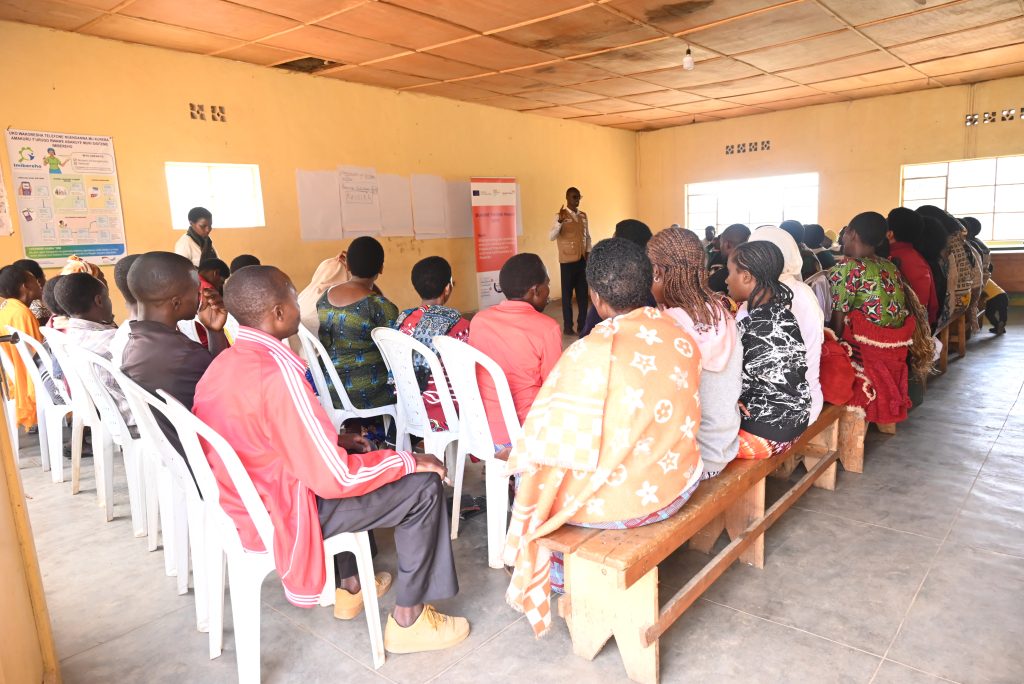
We make sure to teach them they should say “Enough” to waiting for humanitarian aid. For years, the camp environment fostered a belief that survival depended on the World Food Programme. We are currently shifting this narrative. We teach them that they should view themselves as capable economic agents. We emphasize that they possess the inner strength to generate their own income and that they should take pride in feeding their own families. - Saying “Enough” to Vulnerability:
We also teach them they should say “Enough” to being victims of their circumstances. Whether they are refugees displaced by conflict or locals displaced by poverty, we teach them that they have the power to change their trajectory. We teach them that they should be proactive—saving for the future, diversifying their income sources, and protecting their environment against climate shocks. - Saying “Enough” to Division:
We teach them they should say “Enough” to the “Us vs. Them” mentality. By working together in the Dukore Twigire project, we encourage them to see their neighbor not as a competitor for resources, but as a partner in survival.
The Multiplier Effect of Integration
The impact of this approach is visible in the daily life of Nyamagabe.
When a host community member buys vegetables from a refugee’s garden, money circulates locally instead of leaving the district. When a refugee entrepreneur hires a local youth to transport goods, jobs are created. This is the Multiplier Effect.
By treating the camp not as a burden but as a market, and by treating the host community not as a bystander but as a partner, the entire economic ecosystem of the district is strengthened. The road that leads to the camp becomes a road of commerce. The market day becomes a day of exchange, not just of goods, but of ideas and culture.
Conclusion: A Shared Future
In 2026, the distinction between “Displaced” and “Host” is becoming less relevant than the distinction between “Dependent” and “Self-Reliant.”
Livelihood development is the bridge that crosses that divide. It is a slow process, requiring patience, capital, and a fundamental shift in mindset. But as we see in Kigeme, it is working.
When we see a mixed group of women—some Congolese, some Rwandan—counting their savings together under a tree, we are seeing the future of humanitarian aid. It is a future where dignity is earned, where peace is profitable, and where every family, regardless of where they were born, has the opportunity to say “Enough” to poverty and build a life of their own choosing.
At RODI, through the Dukore Twigire Project, we are honored to walk this path with them, supporting the journey from displacement to development, one livelihood at a time.
