
Rwanda is a nation in motion. With a vision set firmly on becoming a knowledge-based economy, the development of human capital is the country’s most valuable asset. However, in the race toward development, a critical challenge remains: ensuring that no child is left behind. For various reasons—ranging from economic instability and family disruptions to learning difficulties or disabilities—a significant number of young people find themselves outside the formal education system.
For these Out-of-School Children and Youth (OOSCY), the traditional school gate often feels permanently closed. They may be too old to join their age-appropriate grade, or they may lack the foundational skills to cope with a standard curriculum. This is where Alternative Learning Pathways (ALPs) step in, not merely as a safety net, but as a strategic launchpad for success.
Redefining Education: What Are ALPs?
Alternative Learning Pathways are distinct from traditional schooling, yet they share the same ultimate goal: empowering the learner. An ALP is designed to be flexible, inclusive, and accelerated. It recognizes that “one size does not fit all” when it comes to education.
In the Rwandan context, ALPs serve as a bridge between the past and the present. They are specifically structured to help over-age learners or those who have dropped out to catch up on years of missed learning in a compressed timeframe. The curriculum is stripped down to the essentials—core literacy, numeracy, and life skills—delivered in a way that respects the learner’s maturity and life experience.
The philosophy behind ALP is profound but straightforward: a child’s future should not be defined by their past circumstances. By providing a non-traditional route to learning, we remove the stigma of being “behind” and replace it with the motivation to move forward.
The Critical Need for “Catch-Up” Strategies
Why are these pathways so essential for Rwanda’s youth success?
- Overcoming Age Stigma: One of the most significant barriers to reintegration is the stigma associated with age. A 14-year-old is unlikely to feel comfortable sitting in a Primary 3 class with 9-year-olds. ALPs create peer groups of similar ages, fostering an environment where dignity is preserved and social learning can thrive.
- Addressing the Learning Gap: When a child misses school for two or three years, the academic gap can feel insurmountable. ALPs use specialized pedagogy to accelerate learning, covering two or three years of curriculum in a single year, allowing students to “catch up” efficiently.
- Building Resilience: Beyond academics, these programs focus on “learning to learn.” They rebuild the confidence that many dropouts have lost, proving to them that they are capable of intellectual growth and success.
Our Contribution: Implementing the LIFT Project in Rusizi District
While the concept of ALP is national, the implementation is intensely local. Under the Learning and Inclusion for Transformation (LIFT) project, funded by the UK’s Foreign, Commonwealth & Development Office (FCDO) and managed by Cambridge Education, our consortium has taken on the responsibility of delivering these life-changing pathways in the Rusizi District.
Our consortium partners, comprised of Action pour le développement du Peuple (ADEPE) and The Umbrella of Organizations of Persons with Disabilities in the Fight against HIV/AIDS & for Health Promotion (UPHLS), are dedicated to operationalizing the ALP model on the ground.
Our specific contribution to the LIFT project mandate in Rusizi includes:
- Targeted Identification and Enrollment: We do not wait for students to come to us; instead, we actively seek them out. We actively engage with local leaders and communities to identify invisible children—those who are out of school and often hidden at home. We assess their specific levels to ensure they are placed in the correct learning pathway.
- Creating Inclusive Learning Spaces: With the expertise of UPHLS, we ensure that our ALP centers are not only open but also accessible. We work to remove physical and attitudinal barriers that often keep children with disabilities out of school, ensuring the ALP environment is welcoming to all abilities.
- Holistic Learner Support: We recognize that academic support alone is insufficient. Our contribution involves providing the necessary scholastic materials to remove economic barriers. Furthermore, we integrate psychosocial support to help learners process the challenges that led them to leave school in the first place.
- Community and Parental Engagement: We act as the link between the learning center and the home. We sensitize parents and guardians on the value of the ALP, turning them from passive observers into active supporters of their children’s education.
- Facilitating Transition: Our job is not finished until the learner moves on. We actively support the transition of ALP graduates, guiding them as they either reintegrate into formal schools (REB system) or pivot toward Technical and Vocational Education and Training (TVET) for immediate skills acquisition.
The Road to Self-Reliance
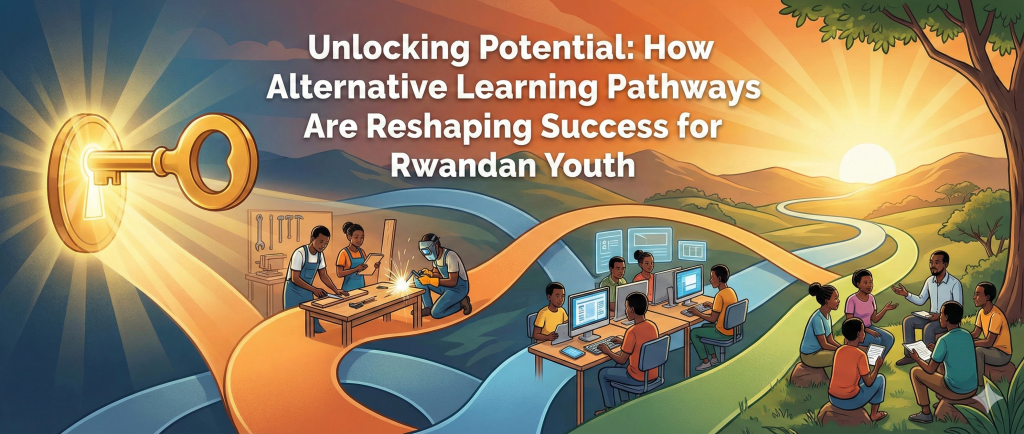
The ultimate measure of success for Rwandan youth is self-reliance. ALPs are a critical tool in achieving this. For some, the pathway leads back to a university degree. For others, it leads to a vocational trade—such as carpentry, tailoring, or digital literacy—that provides a livelihood.
By investing in Alternative Learning Pathways, we are effectively recycling human potential. We are taking young people who were at risk of becoming a burden on the economy and transforming them into active contributors to it.
Conclusion
The implementation of the LIFT project in Rusizi is more than just an educational program; it is a declaration of faith in our youth. It clearly states that it is never too late to learn and that it is never too late to succeed.
Through the LIFT project and the collaborative efforts of RODI, ADEPE, and UPHLS, we are witnessing a shift in the narrative. We are seeing children who had lost hope walk back into classrooms with their heads held high. By championing Alternative Learning Pathways, we are not just teaching lessons; we are unlocking the future of Rwanda, one student at a time.
