
As Rwanda navigates the mid-point of the decade in 2026, the nation’s ambitious journey toward Vision 2050 is in full swing. The narrative of development has evolved beyond physical infrastructure—roads, bridges, and buildings—to a more profound investment: Human Capital. At the heart of this transformation lies a critical, yet often overlooked engine of economic growth: Early Childhood Development (ECD).
In 2026, the discourse around ECD has shifted. It is no longer viewed merely as a social welfare concern or simple “childcare” for working parents. Instead, it is recognized as the primary strategic lever for building a skilled, resilient, and innovative workforce capable of sustaining Rwanda’s growth for decades to come. With the National Strategy for Transformation (NST2) emphasizing quality of life and economic transformation, the foundation laid in the first 1,000 days of a child’s life is now recognized as the cornerstone of the nation’s economy.
For government bodies, development partners, and civil society, the mission is clear: ensure that every Rwandan child, regardless of their geographical location or economic status, has access to the nurturing care required to unlock their full potential. This blog post explores why ECD is the cornerstone of Rwanda’s 2026 workforce strategy, the pillars supporting it, and how specific on-the-ground interventions are turning policy into reality.
The Economic Case: Investing in Brains to Build the Future
The economic argument for Early Childhood Development is irrefutable. Scientific consensus indicates that approximately 90% of a child’s brain development occurs before the age of five. This period constitutes a “window of opportunity” where the architecture of the brain is formed. In 2026, Rwanda’s economic planners and partners understand that the cognitive, social, and emotional skills of the workforce in 2040 are being determined today in ECD settings across the country.
Economists have long noted that the Return on Investment (ROI) for early childhood programs is higher than for any other stage of education. Every franc invested in quality ECD yields significant returns by reducing repetition rates in primary school, lowering dropout rates, and eventually producing adults who are more productive, healthier, and less reliant on social safety nets.
In the context of 2026, where digital literacy and adaptability are paramount, the “soft skills” fostered in high-quality ECD environments—such as curiosity, emotional regulation, and social interaction—are just as valuable as academic knowledge. A child who receives adequate nutrition, stimulation, and protection today is a child who will drive innovation tomorrow. Conversely, failing to address issues such as stunting or a lack of early stimulation acts as a permanent brake on economic potential, limiting the “Demographic Dividend” that Rwanda aims to harness.
The Pillars of a Holistic ECD Strategy
Successful ECD in 2026 is built on a “Nurturing Care Framework” that transcends the classroom. It is a multi-sectoral approach that integrates several key pillars:
- Health and Nutrition: Physical development is the prerequisite for cognitive development. Ensuring children are free from malnutrition and stunting is the first step in preparing them for a life of learning.
- Early Learning and Stimulation: This involves transitioning from rote memorization to play-based learning, which sparks creativity and develops problem-solving skills from a young age.
- Safety and Security: Children must be protected from violence, neglect, and abuse to thrive. Child protection is integral to the ECD mandate.
- Positive Parenting: The home environment remains the first school. Empowering parents with knowledge about child development is essential for continuity of care.
It is within this framework that Civil Society Organizations (CSOs) play a vital role, bridging the gap between national policy and community implementation.
RODI’s Contribution: Monitoring and Supportive Supervision to Home-Based, Community, and Center-based ECDs Facilities in Ruhango District
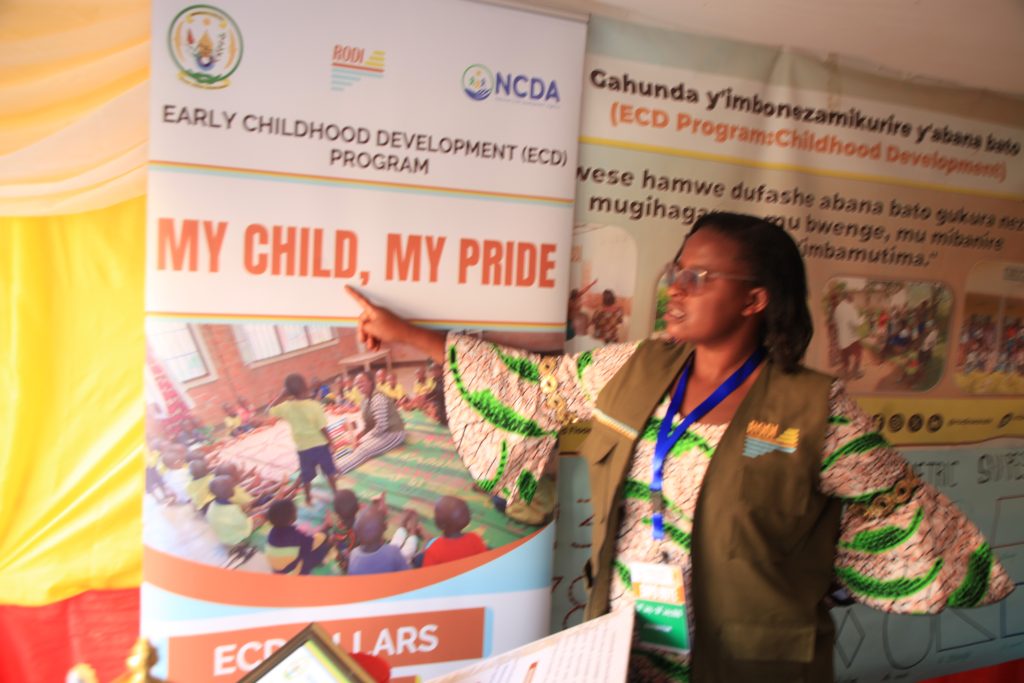
While national policies provide the roadmap, the actual quality of ECD services depends heavily on implementation at the district and sector levels. This is where the Rwanda Organization for Development Initiatives (RODI) has stepped in with a pivotal project titled “Monitoring and Supportive Supervision of ECD Facilities in Ruhango District”“.
This ongoing initiative focuses on a critical, often missing link in development projects: Quality Assurance. Building a classroom is one thing; ensuring that the care provided within it is high-quality, safe, and stimulating is another challenge entirely. RODI’s intervention in Ruhango District is designed to address this by monitoring and supporting three distinct types of ECD facilities:
- Home-Based ECDs: These are small-scale setups often run by parents or neighbors in their own homes. They are essential for reaching the most remote and vulnerable families who cannot easily access larger centers.
- Community-Based ECDs: These facilities are managed by the community, fostering a sense of ownership and collective responsibility for child development.
- Center-Based ECDs: These are more formal institutions that often serve as models for best practices.
Why Supportive Supervision Matters
The project does not simply “inspect” these facilities; it provides supportive supervision. This approach is transformative for several reasons:
- Standardizing Quality: By regularly monitoring these diverse facilities, RODI ensures that they all adhere to the minimum standards required for a child’s holistic development. This prevents a “two-tier” system where only children in urban centers receive quality care.
- Capacity Building for Caregivers: Many caregivers in home-based and community-based settings are volunteers or parents. Through supportive supervision, RODI provides them with on-the-job mentorship, helping them understand how to utilize locally available materials for play, maintain hygiene standards, and recognize signs of developmental delays.
- Holistic Integration (Nutrition & Protection): The supervision extends beyond education. RODI ensures these facilities are safe environments that protect children. Furthermore, given RODI’s broader mission in Nutrition and Food Security, this project supports the implementation of nutrition initiatives, ensuring that ECD centers are also hubs for fighting malnutrition and promoting healthier diets.
- Sustainability and Ownership: By working directly with community structures in Ruhango, the project embeds the value of ECD into the local culture. When the community sees the tangible benefits of quality supervision—happier, healthier, and sharper children—they become the primary guardians of these standards.
This project in Ruhango serves as a microcosm of what is needed nationwide in 2026: a system where every ECD facility, whether in a living room or a dedicated building, is recognized, supported, and held to a standard that guarantees every child a fair start in life.
Challenges That Persist in 2026
Despite the success of projects like the one in Ruhango, the road to universal, high-quality ECD is not without hurdles. As we look across the landscape in 2026, several challenges remain:
- Workforce Capacity: As the number of ECD centers expands to meet the 2026 targets, the demand for trained caregivers outstrips supply. While supportive supervision is helpful, there remains a continuous need for professional training and retention strategies for ECD workforce members.
- Financial Sustainability: Many community-based and home-based centers rely on parental contributions. In low-income areas, this can be unstable. Finding sustainable financing models that do not exclude the poorest families is a priority.
- Infrastructure Gaps: While home-based solutions are effective, some communities still lack basic safe infrastructure (water, sanitation, and hygiene facilities) necessary to host even small groups of children safely.
- Inclusion: Ensuring that children with disabilities are fully integrated into these ECD facilities remains an area requiring intensified focus and specialized resources.
The Way Forward: A Collaborative Future
To overcome these challenges and secure the workforce of the future, a “Whole-of-Society” approach is required.
- Scaling the “Ruhango Model”: The model of monitoring and supportive supervision implemented by RODI in Ruhango should be replicated across other districts. Quality assurance must scale at the same pace as access to information.
- Private Sector Engagement: The private sector must be encouraged to invest in ECD, not just as a philanthropic endeavor, but as a strategic workforce development initiative. This includes supporting ECD centers in the communities where their employees live.
- Parental Empowerment: Continued education is necessary to help parents understand that play is a form of learning. When parents are active partners in the ECD process, the impact of center-based care is multiplied.
Conclusion
In 2026, the question is no longer whether Rwanda should invest in Early Childhood Development, but how to ensure that investment reaches the “last mile”—the child in the most remote village.
Initiatives like RODI’s Monitoring and Supportive Supervision in Ruhango District demonstrate that the answer lies in the details: in the daily interactions between caregivers and children, in the safety of the learning environment, and in the rigorous pursuit of quality standards.
The children playing, learning, and growing in Ruhango’s ECD facilities today are the engineers, doctors, entrepreneurs, and leaders of Rwanda’s tomorrow. By prioritizing their development now, we are not just caring for children; we are securing the prosperity, stability, and innovation of the entire nation for generations to come.
References
- Ministry of Finance and Economic Planning (MINECOFIN). (2020). *Vision 2050: Retrieved from https://www.minecofin.gov.rw/fileadmin/user_upload/Minecofin/Publications/REPORTS/National_Development_Planning_and_Research/Vision_2050/English-Vision_2050_Abridged_version_WEB_Final.pdf
- Ministry of Finance and Economic Planning (MINECOFIN). (2024). *National Strategy for Transformation (NST2), 2024–2029. Retrieved from https://www.minecofin.gov.rw/fileadmin/user_upload/Minecofin/Publications/STRATEGIES/NST_2/NST2_2024-2029_Abridged.pdf
- National Child Development Agency (NCDA). (2019). *National strategic plan 2018–2024.Retrieved from https://www.ncda.gov.rw/fileadmin/user_upload/NDCA/Publications/Guidelines/FInal_Version__NATIONAL_STRATEGIC_PLAN_2018-2024_Approved_17.02.2019.pdf
- National Child Development Agency (NCDA). (2024). National standards for early childhood development in Rwanda.Retrieved from https://www.ncda.gov.rw/fileadmin/user_upload/NDCA/Publications/Guidelines/National_Standards_for_the_Early_Childhood_Development_in_Rwanda.pdf
- Rwanda Organization for Development Initiatives (RODI). (2026). *Official organizational programs and project portfolio: Monitoring and supportive supervision of ECD facilities in Ruhango District*. Retrieved from https://rodirwanda.org.rw/rodi-investing-in-rwandas-future-empowering-early-childhood-development-since-november-2023/
- UNICEF Rwanda. (2018). *Private sector engagement strategy 2018–2023*. Retrieved from https://www.unicef.org/rwanda/media/1236/file/2018-UNICEF-Rwanda-Private-Sector-Engagement-Strategy.pdf
- African Development Bank Group. (2022). *Republic of Rwanda: Country strategy paper 2022–2026*. Retrieved from https://www.afdb.org/sites/default/files/documents/projects-and-operations/rwanda_-_country_strategy_paper_2022-2026.pdf
